Design · 12 min read
Aquascaping without the drama
Wood, stone, and plants that still look decent after they grow in
Hardscape order, a 20-long layout, plants that match your light, and why high-tech carpets fail in a kit LED.
Photo: Unsplash
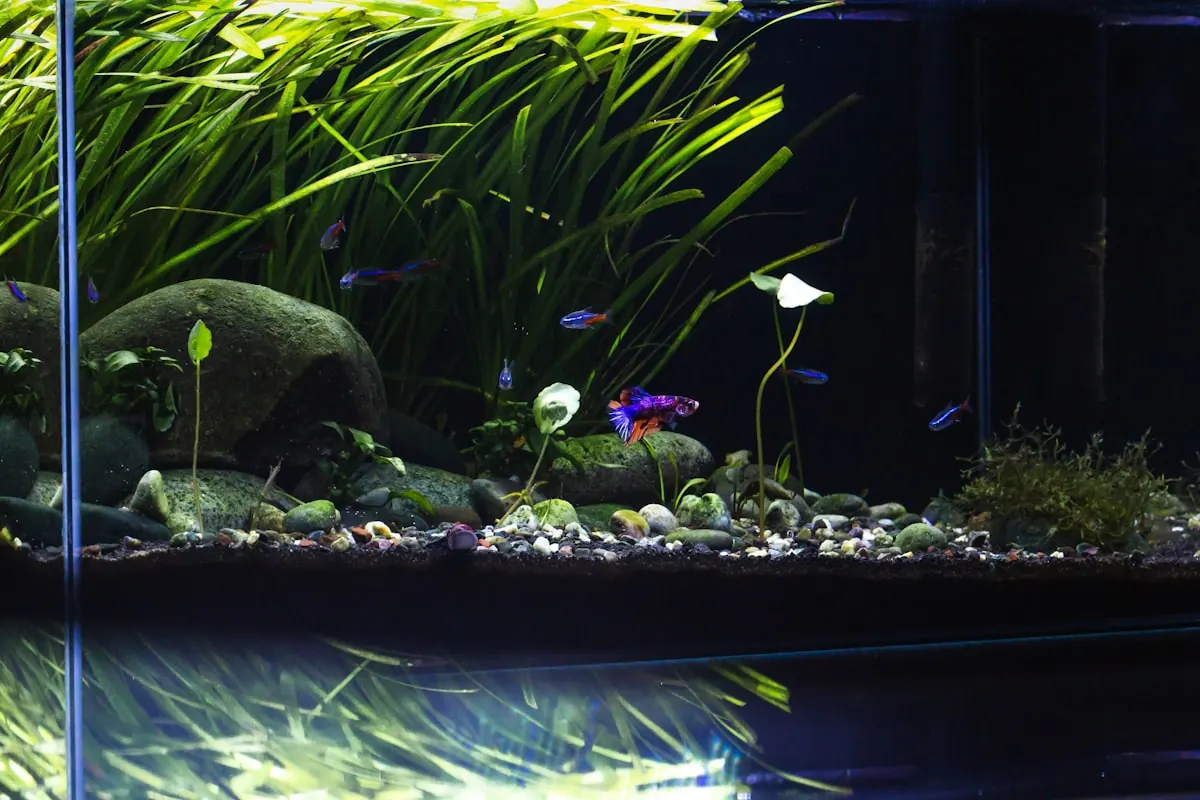
Aquascaping is arranging stone, wood, and plants so the tank reads as a landscape — not a box of ornaments with a plastic diver. You do not need CO₂ and a $400 light to do it. You need a focal point, plants that match the light you actually own, and room for fish to swim.
Hardscape first, plants second, fish last
Dry-fit wood and stone in an empty tank. Look from the front, sitting down, the way you will actually see it. Then add substrate slopes. Then plant. Then cycle. Then livestock.
If you plant first and “see where the wood goes,” you will uproot everything twice.
A 20 long that does not look like a kit
The 20 long (30×12×12″) is the default first planted tank. It is shallow, so kit-level light still reaches the sand.
- Open sand on the right two-thirds. Corys and shrimp use it. You can siphon it.
- Wood on the left third, leaning back, one clear peak. Not a beaver dam wall-to-wall.
- Anubias and java fern tied to the wood — rubber band or thread, not buried. The rhizome rots in gravel.
- A crypt or two in the back left, not a carpet in front.
- Moss on the wood if you want it to look older in a month.
Leave a swim lane down the length. Tetras will use it. A scape that fills every inch photographs well on day one and looks like a hedge by week six.
Run substrate bags for 1.5″ sand on a 30×12 footprint (about two 10 kg bags). Do not buy one bag “for a 20 gallon” and wonder why the glass shows.
Match plants to light — not to Instagram
| Light / CO₂ | Plants that forgive you | Plants that will melt |
|---|---|---|
| Clip-on LED, no CO₂ | Anubias, java fern, java moss, crypts, Vallisneria, Anubias nana | HC Cuba, red Rotala, carpeting seeds in a bottle |
| Decent bar, maybe liquid carbon | Hygrophila, Amazon sword, some Ludwigia, crypts | Anything sold as “needs high light” |
| Strong bar + pressurized CO₂ | Stems, carpets, reds — if you also dose | The same plants under a kit light |
Use lighting before you buy a carpet. High light without fertilizer and CO₂ is an algae farm. CO₂ and fertilizer are the other two legs. Kick one out and the tank tells you with green water or black beard.
Start the photoperiod at 6 hours on a new tank. Ramp later. Algae is usually too much light and leftover food, not a shortage of snails.
Leave room to grow
Stem plants double. Plant stems in small groups with space between, trim the tops, and replant the tops. Overplanting on day one looks full in the shop photo and melts when light and nutrients cannot keep up.
Do not bury Anubias or fern rhizomes. Tie them. Crypts do go in the substrate and often melt once, then return. That melt is not a failed cycle unless ammonia is also up.
Livestock that will not bulldoze it
Midwater schooling fish and shrimp leave wood alone. Goldfish, large cichlids, and most loaches rearrange your weekend.
| Usually fine | Usually not |
|---|---|
| Ember tetras, chili rasboras, small rasboras | Goldfish |
| Corydoras on sand | Common plecos (they grow, they dig) |
| Cherry shrimp in a tank with no hunters | Oscars, most Central American cichlids |
| Otocinclus if the tank is established and feeding biofilm | Crayfish |
Check compatibility before the final list. A pretty scape with a betta that murders the shrimp is still a pretty scape. It is also a dead shrimp tank.
What this is not
You do not need an Iwagumi contest layout. You need one subject, open water, and plants you can keep alive with the light on the lid. The beginner setup is the rest of the kit.
Related
- Freshwater vs saltwater aquariums
Freshwater vs saltwater: cost, equipment, livestock, and why FishBaseHQ stays on the freshwater side of the glass.
- Feeding aquarium fish
How much to feed freshwater fish, how often, what to buy, and why leftover flakes are an ammonia problem — not a kindness.
- Beginner Freshwater Setup
A first community aquarium: which tank size, what filter and heater, how to cycle, and a stocking list that will not collapse in month two.